Summer 2026
From about 70 applicants across its partner institutions, TN-QuMat selected 12 scholars for the 2026 AMPLIFY Scholars cohort. AMPLIFY is a research and professional development program that prepares undergraduate students for research and careers in quantum science, computing, advanced materials, and AI. The 2026 Quantum Research Track offered a paid, 10-week summer research experience from July 10 to September 18, led by Hanna Terletska at Middle Tennessee State University (MTSU).
AMPLIFY is a signature initiative of TN-QuMat, a U.S. Department of Energy RENEW partnership among MTSU, Tennessee State University (TSU), Fisk University, Meharry Medical College, and Oak Ridge National Laboratory (ORNL). It serves as an entry point into the quantum workforce pipeline, bridging the gap between classroom learning and research for STEM students at the earliest stages of their academic careers.
The program focuses on three connected areas: undergraduate research, mentorship, and professional development. Together, they build technical skills and scientific identity, and they prepare scholars for graduate school and for competitive opportunities such as NSF Research Experiences for Undergraduates (REU), DOE Science Undergraduate Laboratory Internships (SULI) at ORNL, the Goldwater Scholarship, and the NSF Graduate Research Fellowship (GRFP).
A Cohort Across Disciplines and Institutions
The 2026 cohort brought together students from physics, biochemistry, computer science, mathematics, and data science. Seven scholars came from MTSU, three from Fisk University, one from TSU, and one from Meharry Medical College. Scholars spent about 20 hours a week on research.
Research Mentorship
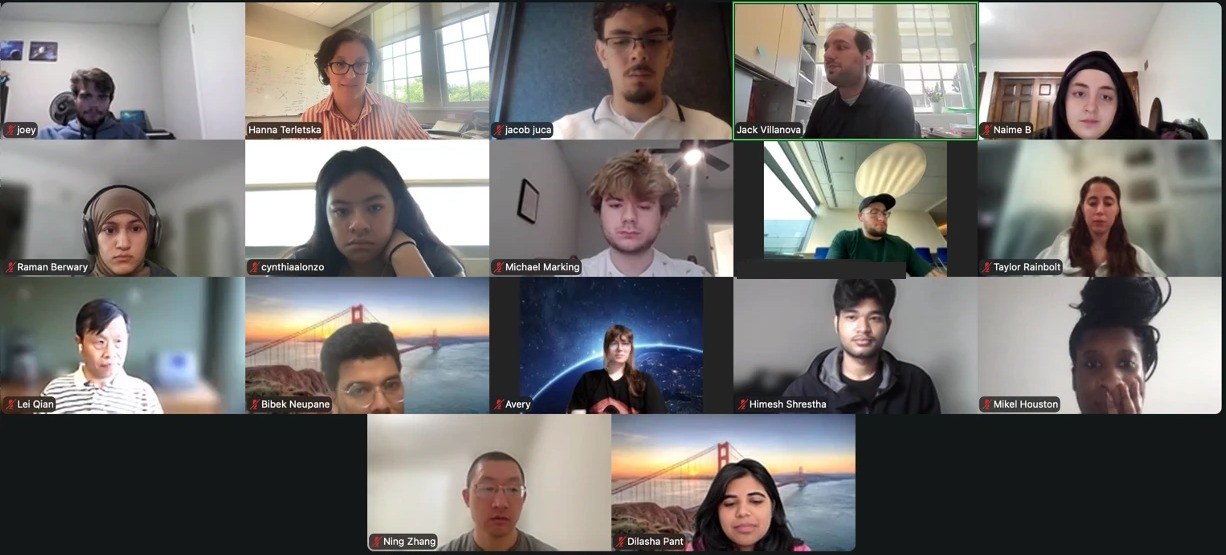
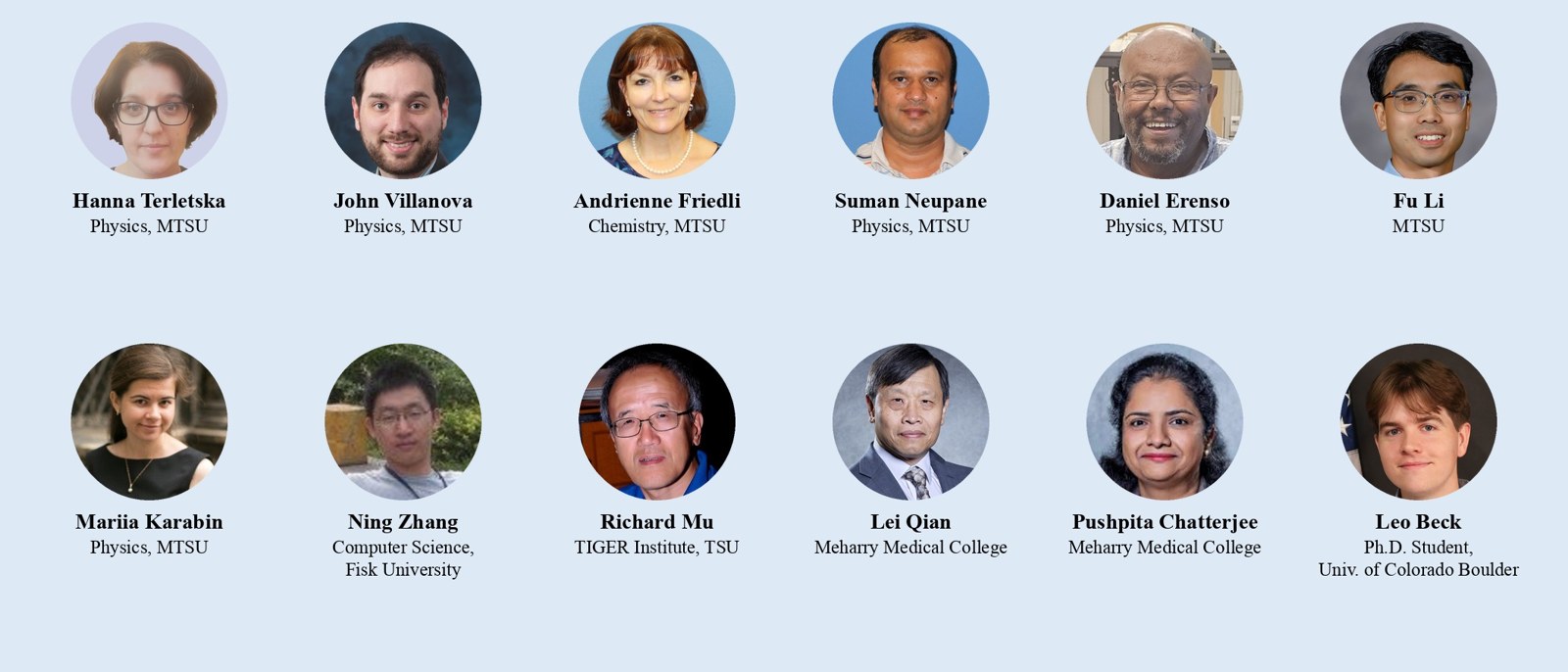
Each scholar was matched with one or two research mentors to work on a research project in quantum science, computing, materials, or AI. Twelve mentors from MTSU, Fisk University, TSU, Meharry Medical College, and the University of Colorado Boulder guided the 2026 scholars, bringing expertise that spans theory, computation, and experiment. Scholars met weekly with their faculty mentors on research, in addition to meeting as a cohort on Fridays via Zoom, and received guidance on graduate school and fellowship applications.
Scholars followed a clear research model: read the literature, reproduce a benchmark result, and then extend it with one new contribution. Along the way, they kept research logs, used computing and laboratory resources across the partnership, and presented their progress to the cohort.
Projects spanned three broad areas, from modeling and simulating quantum materials to quantum sensing and quantum-safe computing, giving scholars experience in theoretical, computational, and laboratory research.
Quantum materials and modeling.
- Michael Marking (MTSU): Altermagnetic materials by design, using density functional theory to verify band splitting in candidate bilayers (mentor: John Villanova, MTSU)
- Avery Finch and Joey Buckingham (MTSU): The impact of the Hartree term in the DMFT-CPA framework (mentor: Hanna Terletska, MTSU)
- Dilasha Pant (Fisk University) and Naime Beyza Gokce (MTSU): Machine learning and computational studies of perovskites (mentors: Mariia Karabin, MTSU; Leo Beck, Ph.D. student, University of Colorado Boulder)
- Nalina Karkee (TSU): Nanofiber chopping analysis of fiber and wire diameters from SEM images (mentor: Richard Mu, TSU)
Qubits, quantum optics, and quantum sensing.
- Cynthia Alonzo (MTSU): Blatter radical derivatives as electron qubits for quantum materials (mentor: Andrienne Friedli, MTSU)
- Raman Berwary (MTSU): Plasmon-enhanced metal-oxide nanowire quantum sensors (mentor: Suman Neupane, MTSU)
- Jacob Juca (MTSU): Whispering-gallery-mode resonators for quantum-enhanced sensing (mentor: Fu Li, MTSU)
- Joey Buckingham (MTSU): Relativistic Doppler effects in a quantum teleportation scheme using entangled twin photons (mentor: Daniel Erenso, MTSU)
Quantum computing, AI, and security.
- Himesh Shrestha (Fisk University): Hybrid quantum machine learning for medical image classification (mentors: Ning Zhang, Fisk University; Lei Qian, Meharry Medical College)
- Bibek Neupane (Fisk University): Quantum threats and post-quantum cryptography for secure communication (mentor: Lei Qian, Meharry Medical College)
- Mikel Houston (Meharry Medical College): A data-driven framework for hybrid and adaptive post-quantum cryptography in bio-sensing (mentor: Pushpita Chatterjee, Meharry Medical College)
Professional Development
Research skills alone do not open the door to graduate school or national laboratories. Scholars must also read the literature critically, communicate their results, and present themselves well in competitive applications, and these skills are not always taught in the classroom. AMPLIFY therefore pairs each research project with a weekly Friday cohort meeting on Zoom, so that scholars practice these skills using their own work and learn alongside peers from other institutions and disciplines.
- Reading and writing science. Early sessions introduced expectations and research practice, how to read a scientific paper, and how to prepare scientific documents with Overleaf and LaTeX, giving scholars tools they applied directly to their projects.
- Communicating research. Workshops on giving scientific talks and on designing effective posters, led by Hanna Terletska and Jack Villanova, prepared scholars to present their work. Scholars presented their progress to the cohort, received feedback from peers and faculty, and at the end of the program each gave a 15-minute presentation of their work.
- Faculty research spotlights. Mentors shared their own research and career paths, including Jack Villanova on first-principles calculations for quantum materials, Ning Zhang on AI for understanding the human brain, and Lei Qian on quantum machine learning and explainable AI for cancer diagnosis. These sessions showed scholars the breadth of research across the partnership.
- Applications and next steps. A dedicated session covered how to apply to graduate school, NSF REU, DOE SULI, and the Goldwater Scholarship, including how to find programs, plan for deadlines, and build a strong application. Scholars also learned to give and receive feedback through peer review.
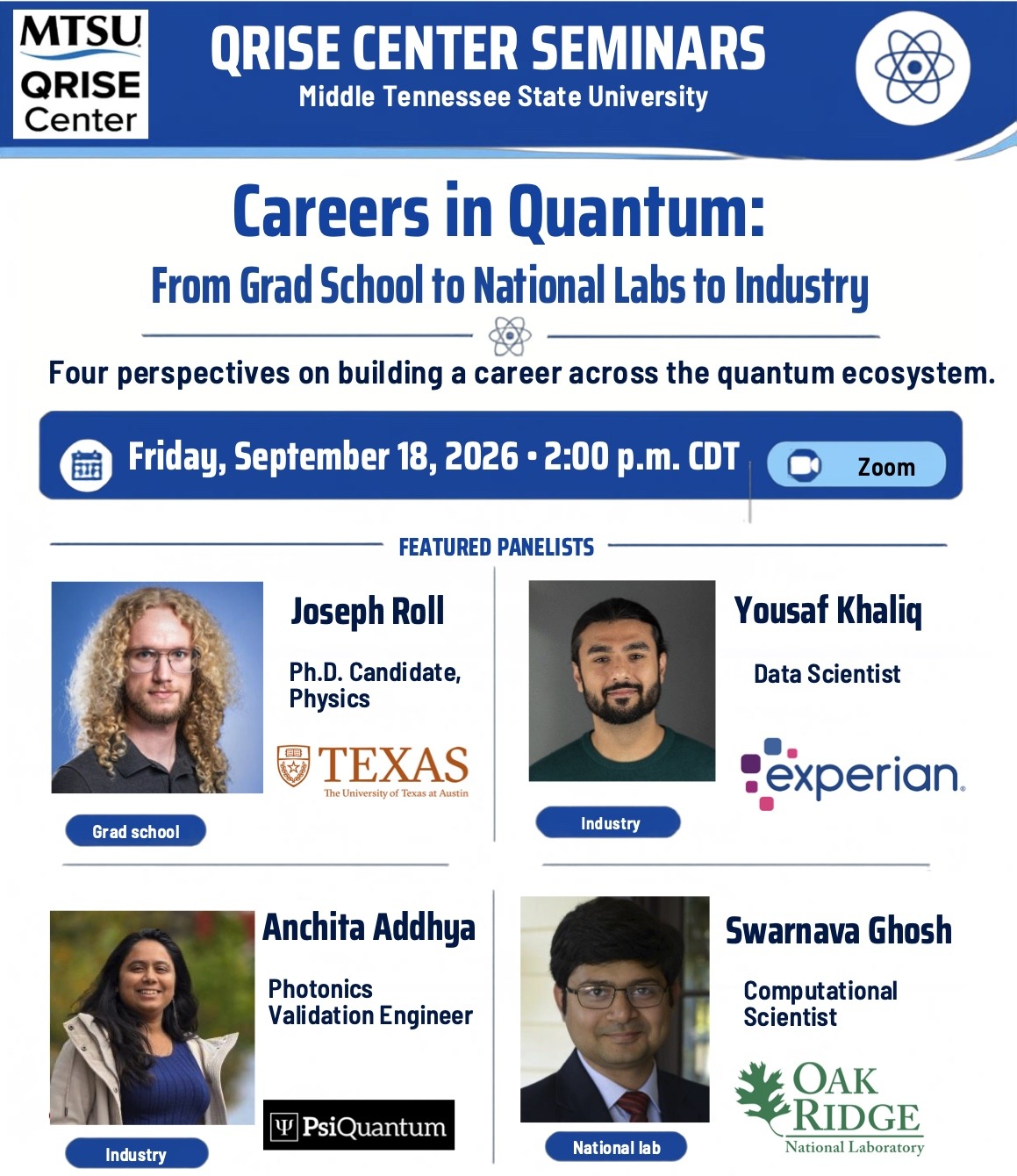
- Careers in quantum. A QRISE Center panel on September 18, “Careers in Quantum: From Grad School to National Labs to Industry,” gave scholars four perspectives on building a career in the field, from Joseph Roll (Ph.D. candidate, University of Texas at Austin), Yousaf Khaliq (data scientist, Experian), Anchita Addhya (photonics validation engineer, PsiQuantum), and Swarnava Ghosh (computational scientist, ORNL).
The program was designed so that each scholar finishes with a research abstract, a short report, a poster, an updated CV, and a competitive application package. Scholars are now applying these materials toward REU programs and graduate school.
Acknowledgment
The AMPLIFY Scholars Program is part of TN-QuMat, supported by the U.S. Department of Energy RENEW program under award DE-SC0025748. For more about TN-QuMat, visit https://tn-qumat.org.