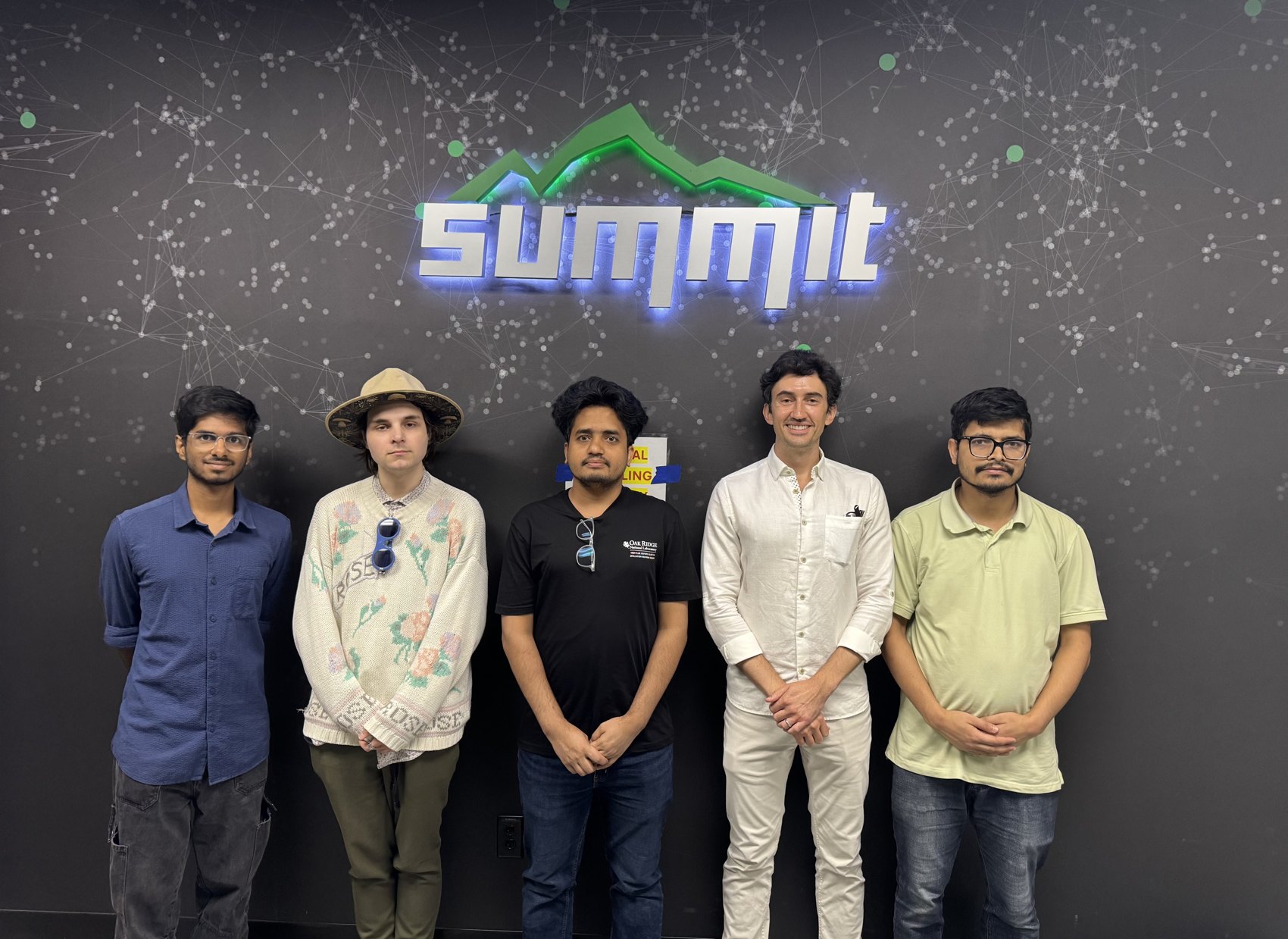
Summer 2026 • Oak Ridge National Laboratory
Five TN-QuMat trainees spent summer 2026 working at Oak Ridge National Laboratory (ORNL) through the TN-QuMat Summer Internship Program, a paid, 10-week research experience supported by the U.S. Department of Energy RENEW program. Each intern worked on a TN-QuMat research project with mentors from their home universities and ORNL.
The program connects students with national laboratory research at an early stage of their careers. The 2026 cohort included two undergraduates, one master’s student, and two Ph.D. students from Fisk University, Middle Tennessee State University (MTSU), Virginia Tech, and the University of Kansas.
An Internship Built Around National Laboratory Research
TN-QuMat is a partnership among MTSU, Tennessee State University (TSU), Fisk University, Meharry Medical College, and ORNL. Its summer internship places trainees within ORNL research groups, including those of Thomas Maier, Tom Berlijn, and Markus Eisenbach, and organizes research around three quantum materials thrusts: many-body modeling and simulation, first-principles computing, and the synthesis and characterization of materials. The program is built around whole-scholar development, combining original research with training for the next step in each intern’s career.
The internship offers trainees:
- Research at a national laboratory. Original research embedded in ORNL research groups, alongside scientists at the nation’s largest DOE science and energy laboratory.
- World-leading facilities. Access to resources including the Center for Nanophase Materials Sciences (CNMS), ORNL’s neutron sources, the Spallation Neutron Source and the High Flux Isotope Reactor, and the Frontier supercomputer.
- A wider scientific community. ORNL summer schools, laboratory-wide seminars, facility tours, lectures, and networking with scientists and engineers.
- Research communication. Paper reading and discussion of primary literature, and experience building and presenting a scientific poster.
- Mentoring for what comes next. One-on-one mentoring and personalized support for graduate school and fellowships, including DOE SULI, NSF REU, the NSF Graduate Research Fellowship, and the Goldwater Scholarship.
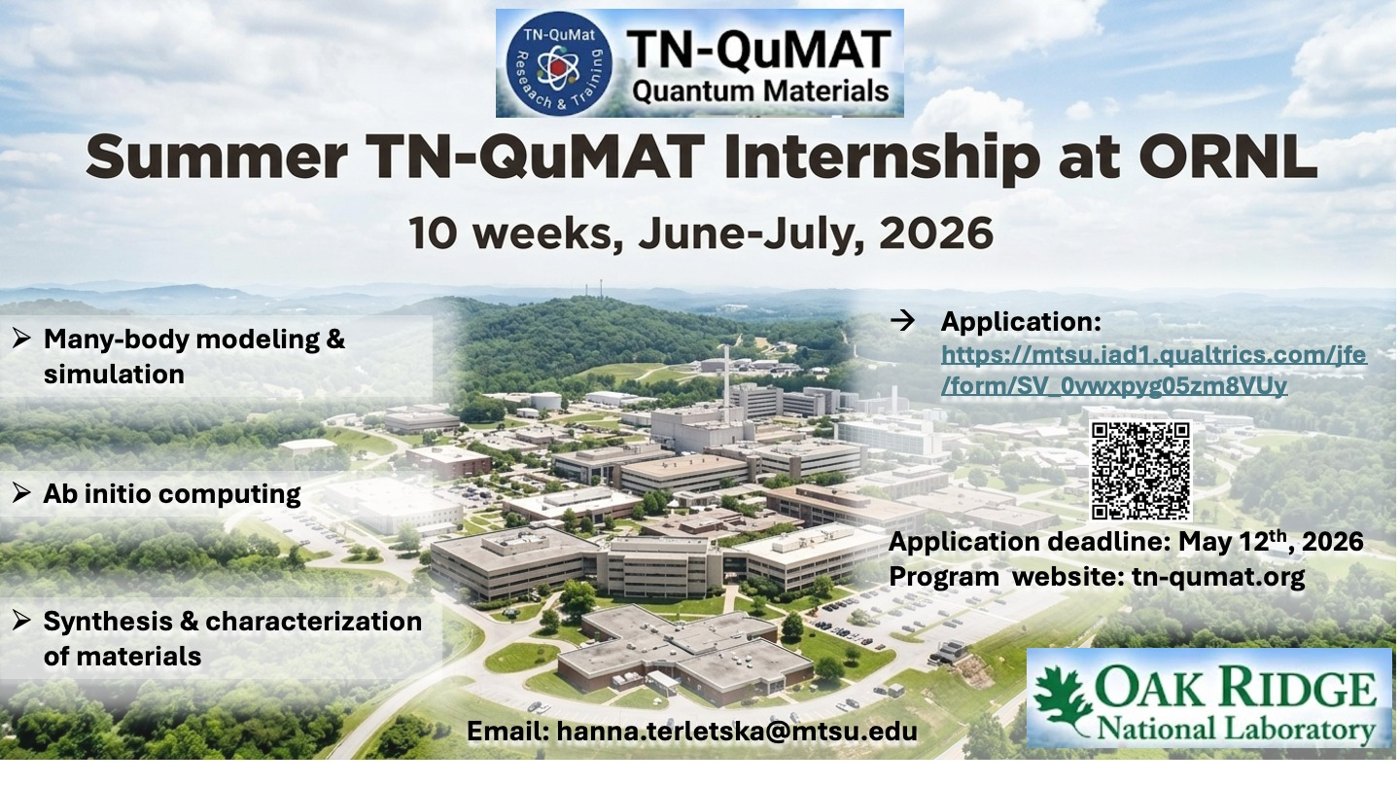
Learn more about the TN-QuMat Summer Internship Program.
Intern Research Projects
Tyler Sax
M.Sc. student, Fisk University
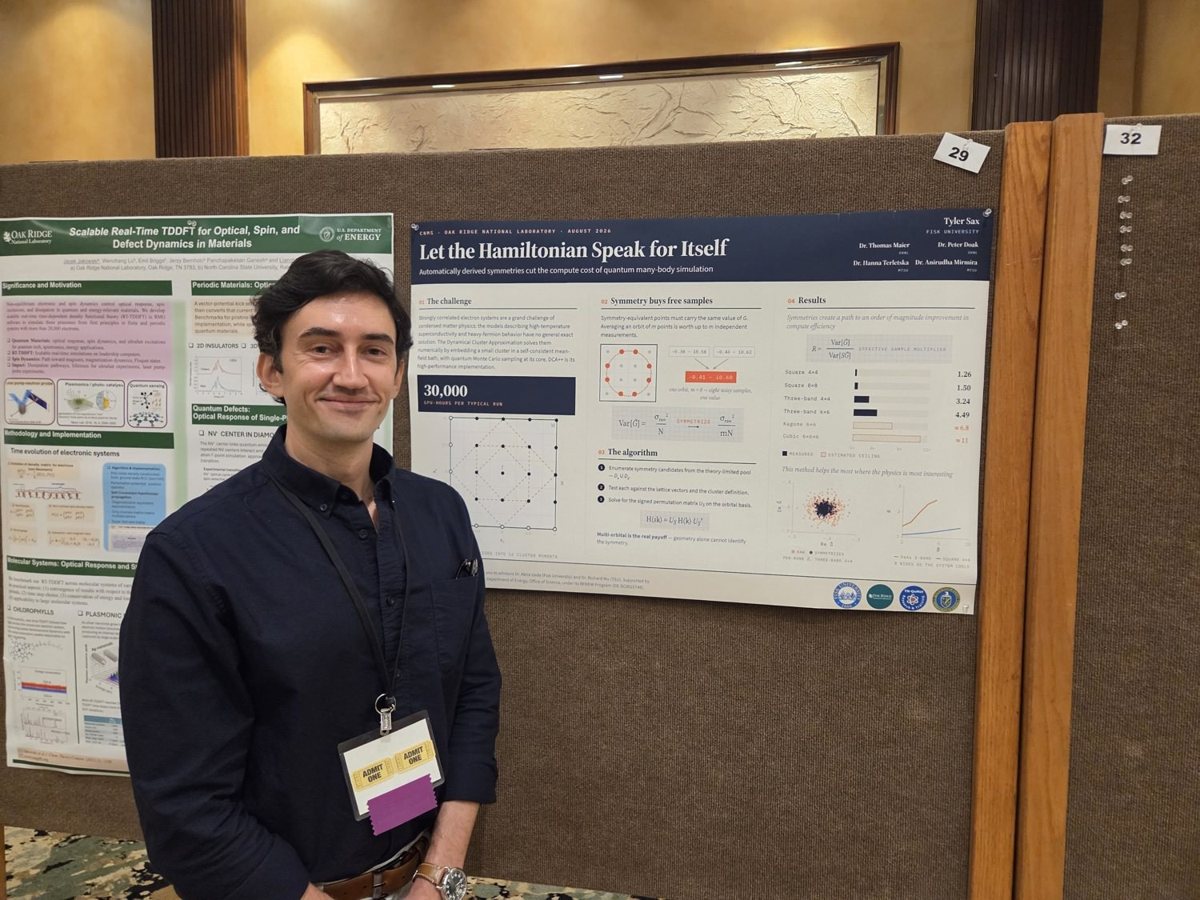
Automatic symmetries for faster quantum simulation. Tyler worked on DCA++, the quantum many-body code developed at ORNL, to derive and apply symmetries automatically from the Hamiltonian. Because symmetry averaging reduces measurement noise, the method lowers the compute cost of quantum Monte Carlo simulations, with an improvement of about 4.5 times in a three-band model on a 6×6 cluster.
Mentors: Thomas Maier and Peter Doak (ORNL), with Hanna Terletska and Anirudha Mirmira (MTSU), Akira Ueda (Fisk), and Richard Mu (TSU).
Bishal Tiwari
Ph.D. student in Chemistry, MTSU and Virginia Tech
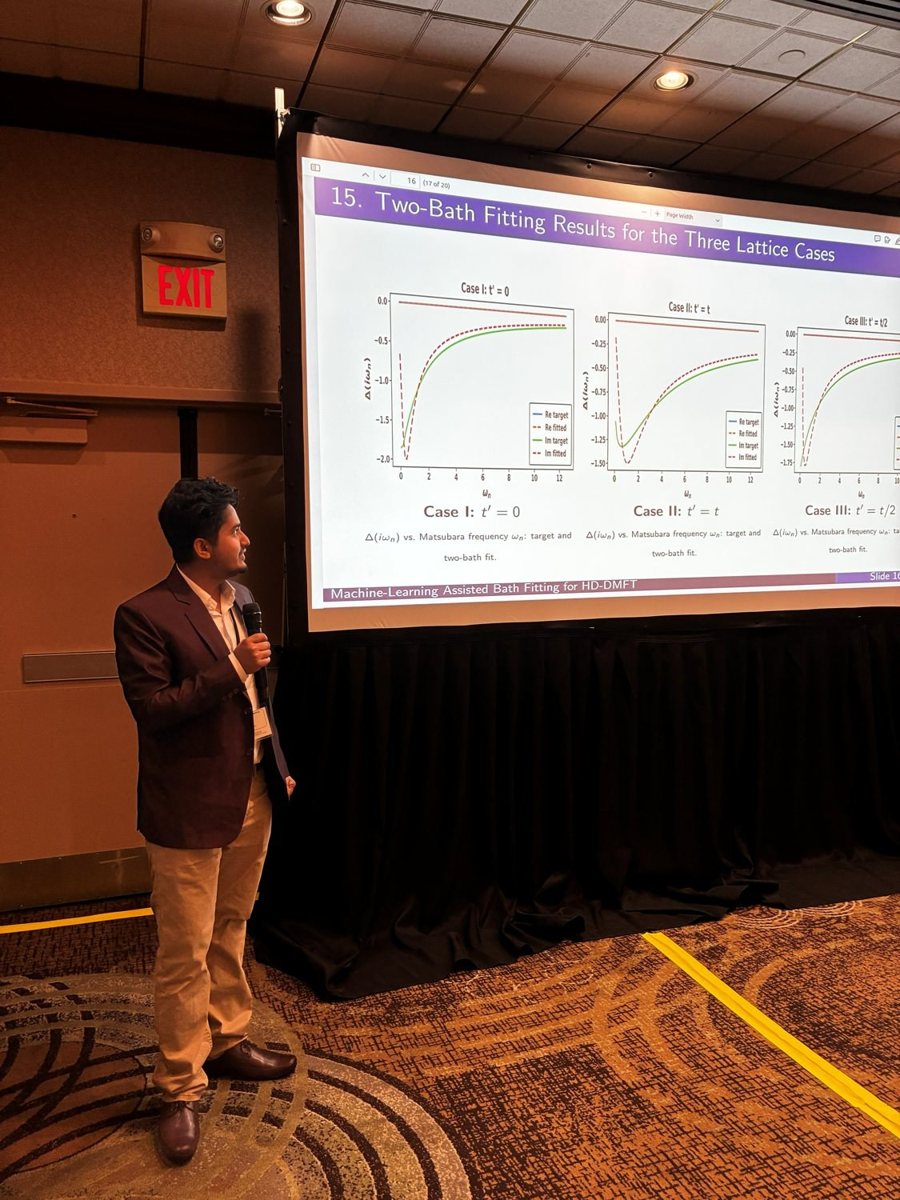
Machine learning for dynamical mean-field theory. Bishal used machine learning to fit the bath parameters of Anderson impurity models, a key step in dynamical mean-field theory, including how accuracy and the number of fitting parameters change as more bath sites are added.
Mentors: Markus Eisenbach and Swarnava Ghosh (ORNL) and Hanna Terletska (MTSU).
Aditya Sunke
Undergraduate, Computer Science and Quantum Information Science, MTSU and Virginia Tech
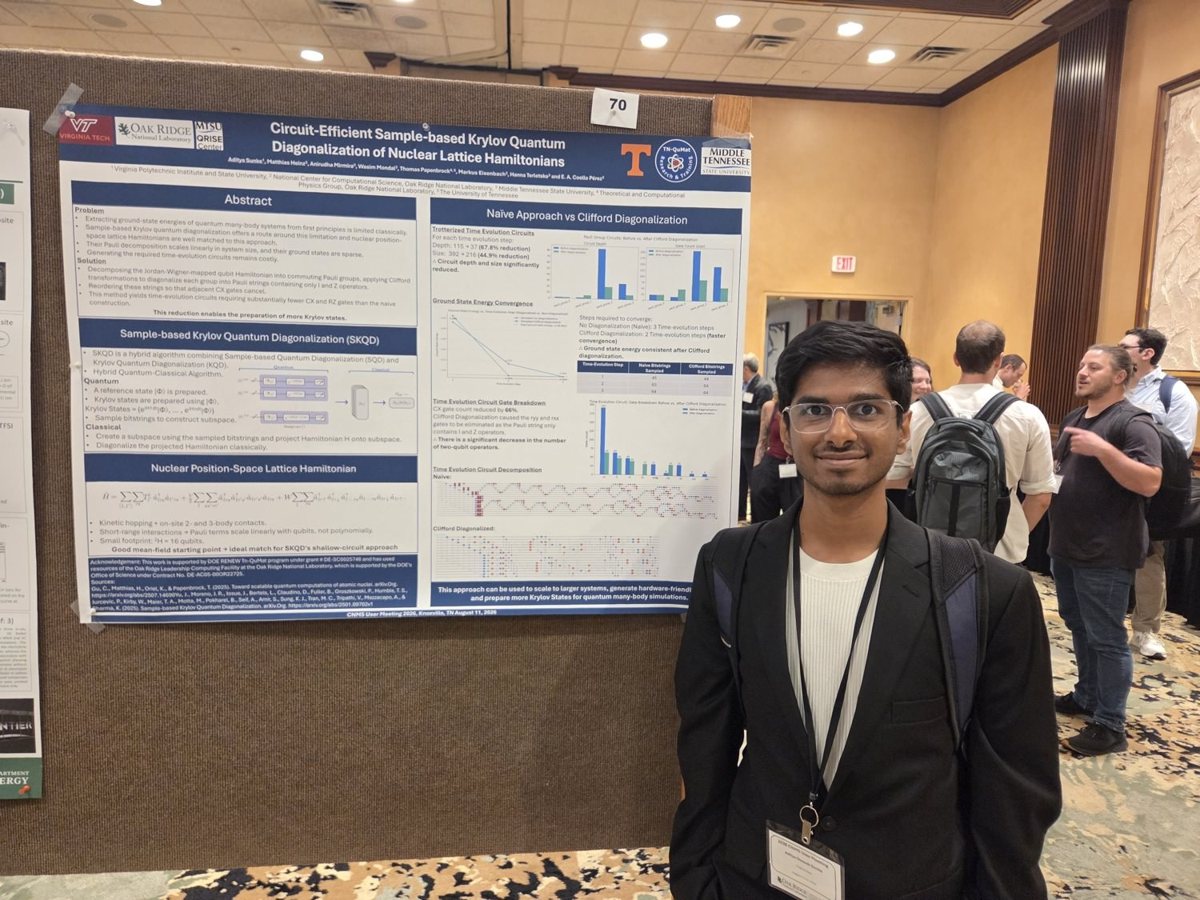
Quantum algorithms for nuclear physics. Aditya developed circuit-efficient methods for sample-based Krylov quantum diagonalization of nuclear lattice Hamiltonians. The approach substantially reduces circuit cost, with one comparison showing circuit depth falling from 115 to 37, a 67.8 percent reduction.
Mentors: E. A. Coello Pérez, Matthias Heinz, and Markus Eisenbach (ORNL) and Hanna Terletska (MTSU).
Ivy Morelli
MTSU
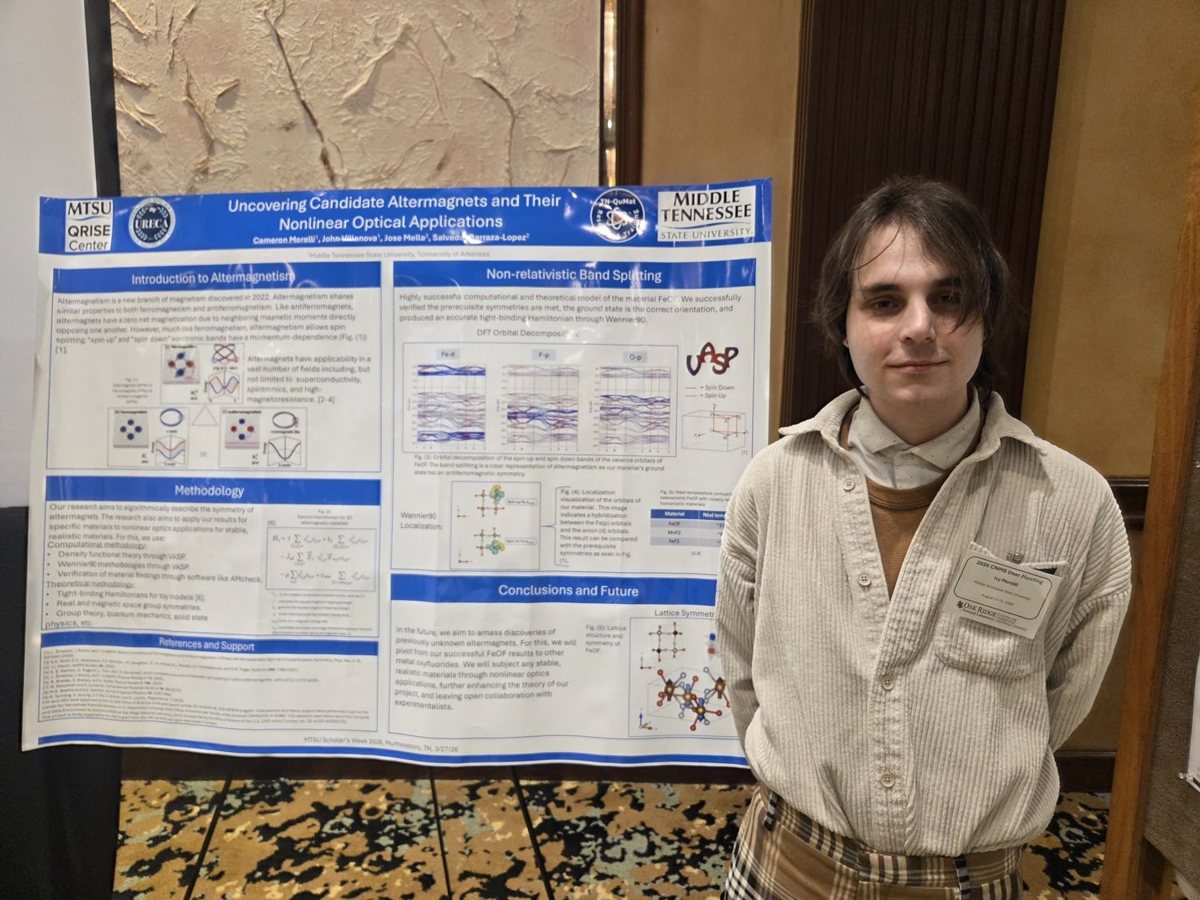
Discovering new altermagnets. Ivy searched for candidate altermagnets, a new class of magnetic materials, examining their nonrelativistic spin splitting and potential nonlinear optical applications.
Mentors: Tom Berlijn and Thomas Maier (ORNL) and Jack Villanova (MTSU).
Narendra Phulara
MTSU and University of Kansas
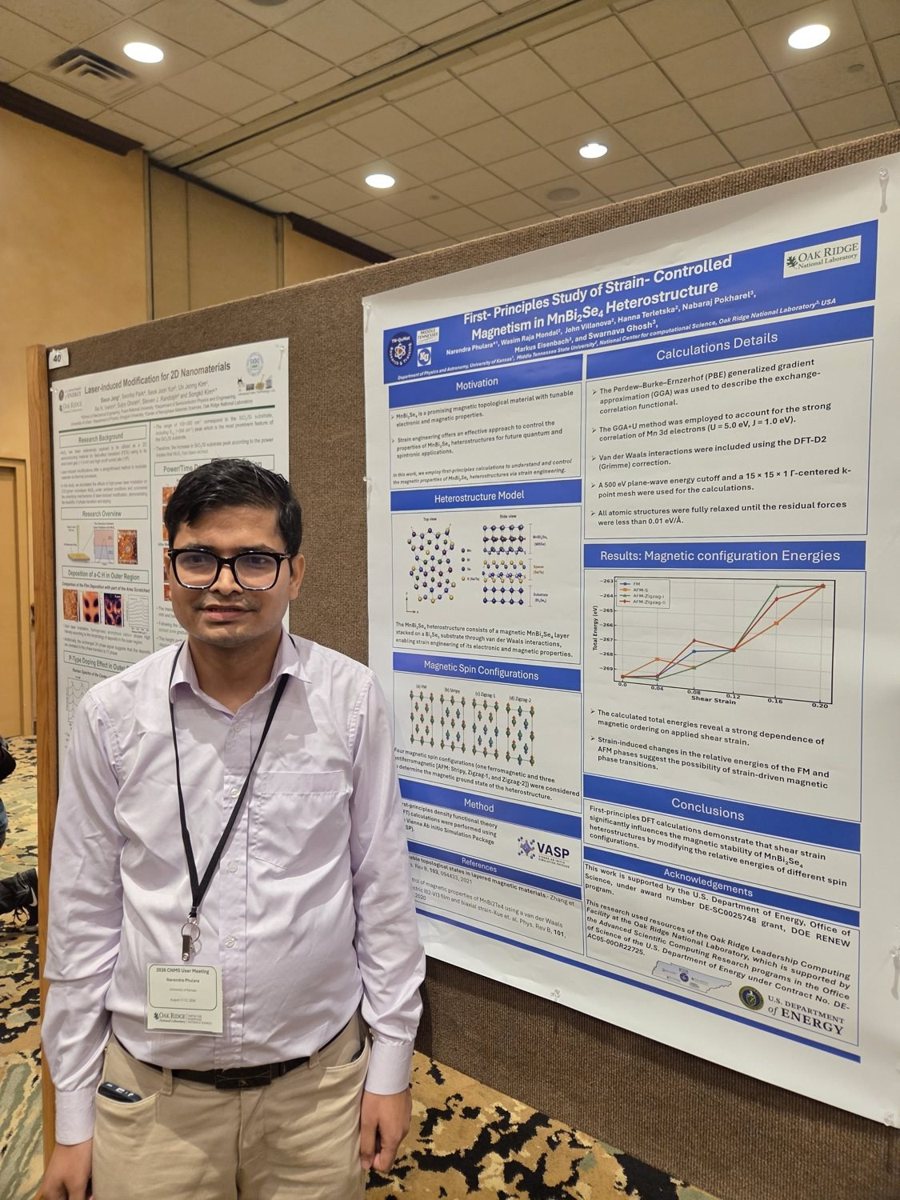
Controlling magnetism with strain. Using first-principles calculations, Narendra studied how shear strain affects the magnetic ground state of MnBi2Se4 heterostructures, comparing ferromagnetic and antiferromagnetic phases and finding that strain changes their relative energies.
Mentors: Swarnava Ghosh and Markus Eisenbach (ORNL), with Jack Villanova, Wasim Mondal, and Hanna Terletska (MTSU).
Sharing Results with the Research Community
The interns presented their work at the 2026 Center for Nanophase Materials Sciences (CNMS) User Meeting in Knoxville on August 11–12, 2026. Tyler Sax and Bishal Tiwari gave talks, and Aditya Sunke, Ivy Morelli, Narendra Phulara, and Tyler Sax presented posters. Read more in our story on the CNMS User Meeting.
Photos
Acknowledgment
The TN-QuMat Summer Internship Program is supported by the U.S. Department of Energy RENEW program under award DE-SC0025748. For more about TN-QuMat, visit https://tn-qumat.org.